

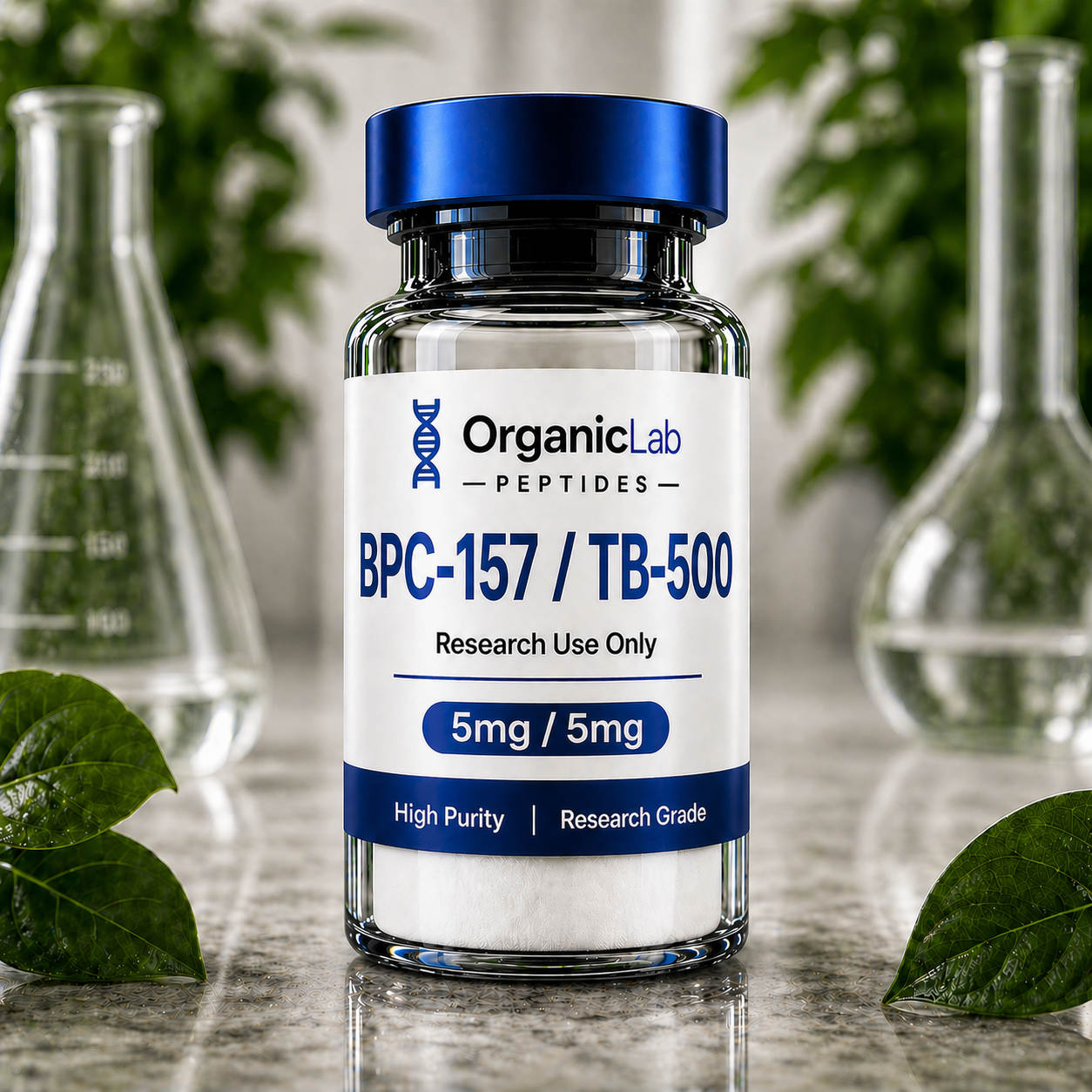
Synergistic Repair Blend
Two Peptides, One Protocol: A Dual-Pathway Approach to Tissue Repair
This research blend pairs BPC-157 and TB-500 (Thymosin Beta-4) — two peptides with well-characterized but mechanistically distinct roles in tissue repair. BPC-157, a stable pentadecapeptide derived from gastric protein, acts primarily through angiogenesis and growth factor modulation. TB-500, a 43-amino-acid actin-binding molecule, facilitates cytoskeletal remodeling and directed cell migration. Their combination engages multiple repair pathways that neither peptide fully activates alone.
- BPC-157 and TB-500 combined in a single research formulation
- Mechanistically distinct yet complementary pathways
- BPC-157: Vascular repair and growth factor signaling
- TB-500: Actin dynamics and cell motility
- Preclinical data supporting synergistic tissue repair outcomes
For laboratory research use only. Not for human consumption.

Dual Mechanism of Action
How BPC-157 and TB-500 Reinforce Each Other at the Cellular Level
Effective tissue repair depends on cells reaching the injury site, having the structural capacity to proliferate, and receiving appropriate growth signals. BPC-157 addresses the signaling side — it upregulates actin gene expression and enhances growth hormone receptor density on fibroblasts, extending their functional lifespan. TB-500 addresses the structural side — it sequesters actin monomers and directs their assembly into the filaments required for cell movement. The result is a coordinated repair environment where both the quantity and utilization of actin are simultaneously optimized.
- BPC-157: Upregulates actin expression at the transcriptional level
- TB-500: Sequesters and redirects actin monomers for filament assembly
- BPC-157: Enhances GH receptor expression on fibroblasts
- TB-500: Supports sustained cell motility through actin reserves
- Combined: Improved fibroblast recruitment and migration to injury
For laboratory research use only. Not for human consumption.

Research Applications
Musculoskeletal, Soft Tissue and Wound Healing Research
The BPC-157/TB-500 combination is particularly well-suited for research where multi-pathway tissue repair is the primary endpoint. By addressing vascular remodeling, inflammatory resolution, cellular migration, and structural remodeling simultaneously, this blend allows investigators to study how coordinated peptide action compares to single-agent protocols — a relevant question for tendon, muscle, and soft tissue repair models.
- Tendon and ligament repair modeling
- Skeletal muscle injury and recovery studies
- Wound healing kinetics and tissue remodeling assays
- Anti-inflammatory pathway investigation
- Angiogenesis and vascular remodeling research
- Comparative single-peptide vs. combination protocol studies
For laboratory research use only. Not for human consumption.

BPC-157 + TB-500: The Case for Combination Peptide Research
The BPC-157/TB-500 blend brings together two peptides with well-documented but mechanistically non-overlapping contributions to tissue repair. Each compound is supported by an independent body of preclinical literature, and their combination is increasingly used in research designs exploring whether multi-pathway engagement produces additive or synergistic outcomes in healing models.
BPC-157 is a stable 15-amino-acid peptide derived from a gastric cytoprotective protein. Its documented effects include promotion of angiogenesis, modulation of nitric oxide signaling, and upregulation of growth hormone receptor expression on fibroblasts — which extends their proliferative capacity and responsiveness to repair signals. Research also shows BPC-157 increases actin transcription, providing a larger pool of the cytoskeletal protein for downstream use.
TB-500 (Thymosin Beta-4) operates on that same actin pool, sequestering monomeric G-actin and directing its assembly into the filamentous networks cells require for directed migration. Without adequate actin dynamics, fibroblasts and endothelial cells cannot efficiently reach or populate damaged tissue. TB-500 resolves this bottleneck — and with BPC-157 simultaneously increasing the available actin supply, the two compounds create a mutually reinforcing repair environment.
For research teams studying musculoskeletal repair, wound healing biology, or the pharmacology of peptide combinations, this blend provides a dual-pathway platform supported by independent preclinical evidence for each component, and an emerging rationale for their use in concert.
For research use only. Not for human consumption.