

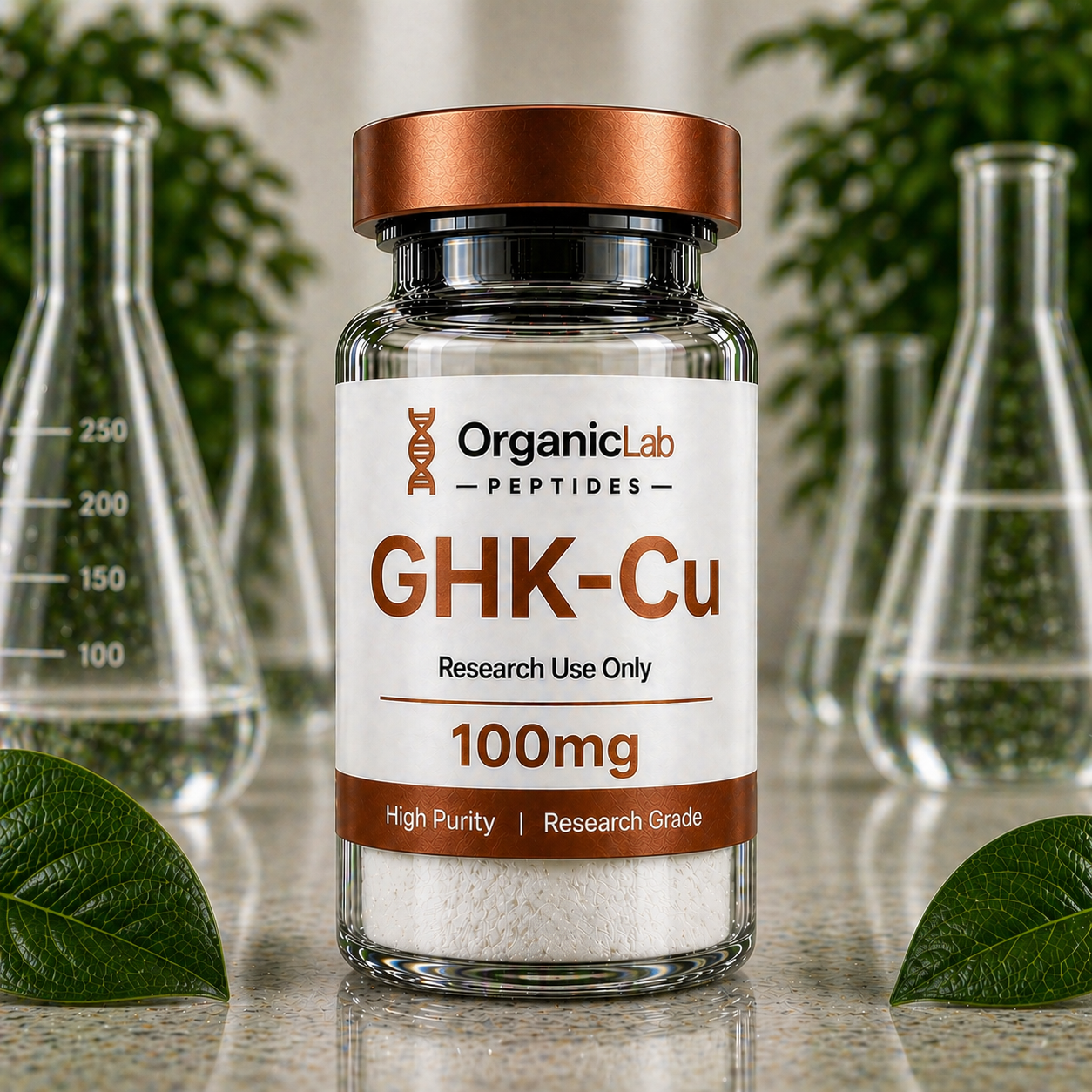
Copper Tripeptide Complex
An Endogenous Copper-Binding Tripeptide at the Center of Tissue Repair Biology
GHK-Cu is a naturally occurring copper-chelating tripeptide (glycyl-L-histidyl-L-lysine) found in human plasma, saliva, and urine. It functions as an endogenous repair signal — activating fibroblast activity, stimulating collagen and glycosaminoglycan synthesis, and promoting angiogenesis. Its plasma concentration declines substantially with age, from elevated levels in young adults to significantly lower concentrations by age 60, a pattern that has made it a focus of research into age-related tissue deterioration and regenerative biology.
- Naturally occurring copper-chelating tripeptide found in human plasma
- Stimulates collagen and glycosaminoglycan synthesis
- Activates fibroblasts and promotes new vessel formation
- Documented antioxidant and cytoprotective properties
- Plasma levels decline significantly with advancing age
For laboratory research use only. Not for human consumption.

Multi-Pathway Regeneration
Copper Delivery, Gene Modulation and Extracellular Matrix Remodeling
GHK-Cu operates through two interlocking roles. As a copper chaperone, it delivers bioavailable copper to cuproenzymes including lysyl oxidase — the enzyme responsible for cross-linking collagen and elastin fibrils into structurally competent tissue. As a genomic regulator, it modulates the expression of a broad network of genes governing matrix synthesis, inflammatory signaling, and tissue remodeling — including coordinated regulation of matrix metalloproteinases and their inhibitors to support organized rather than destructive matrix turnover.
- Delivers copper to lysyl oxidase, supporting collagen and elastin cross-linking
- Regulates expression of genes spanning tissue repair and inflammatory pathways
- Coordinates MMP and TIMP activity for balanced matrix remodeling
- Upregulates decorin, supporting organized collagen fibril architecture
- Suppresses pro-inflammatory cytokines including IL-6 and TNF-α
For laboratory research use only. Not for human consumption.

Research Applications
Wound Healing, Dermal Regeneration and Age-Related Tissue Research
GHK-Cu has been studied across a wide range of tissue repair applications. Human clinical data supports its involvement in chronic wound healing and post-procedure skin recovery, while preclinical research continues to explore its role in hair follicle biology, connective tissue repair, and emerging neuroprotective applications. Its dual function as copper transporter and gene-level repair signal makes it particularly versatile for multi-endpoint regenerative studies.
- Chronic wound and ulcer healing research
- Dermal regeneration and skin matrix remodeling studies
- Post-procedure tissue recovery modeling
- Hair follicle biology and dermal papilla research
- Connective tissue integrity and scar formation studies
- Neuroprotective pathway exploration
For laboratory research use only. Not for human consumption.

GHK-Cu: A Copper Peptide with Broad Relevance to Regenerative and Aging Research
GHK-Cu (glycyl-L-histidyl-L-lysine complexed with copper) is one of the most extensively characterized peptides in regenerative biology. First isolated from human plasma in the 1970s, it has since been shown to influence a remarkably broad network of biological processes — from extracellular matrix remodeling and wound repair to inflammatory regulation and cellular defense against oxidative stress. Its documented decline with age has positioned it as a subject of sustained interest in research on tissue aging and age-related repair deficits.
Its mechanism involves two distinct but interrelated functions. In its role as a copper chaperone, GHK-Cu binds and transports ionic copper in a bioavailable form, delivering it to cuproenzymes that depend on copper for catalytic activity. Lysyl oxidase, which cross-links collagen and elastin to create mechanically competent extracellular matrix, is a key recipient. Superoxide dismutase 1 (SOD1), a primary antioxidant enzyme, is another. This delivery function supports the structural and oxidative dimensions of tissue maintenance simultaneously.
As a gene regulatory signal, GHK-Cu influences the expression of a large network of genes associated with tissue repair, matrix remodeling, and inflammatory resolution. It coordinates the activity of matrix metalloproteinases and their tissue inhibitors — enabling productive matrix turnover without the excessive degradation associated with chronic wounds or fibrosis. Upregulation of decorin, a proteoglycan that organizes collagen fibril spacing, contributes to the structural quality of regenerated tissue rather than disorganized scar formation.
For research teams investigating wound biology, dermal regeneration, extracellular matrix pharmacology, age-related tissue decline, or the intersection of copper metabolism and repair, GHK-Cu provides a well-characterized, multi-pathway research compound with decades of supporting literature spanning in vitro, preclinical, and clinical wound healing studies.
For research use only. Not for human consumption.