

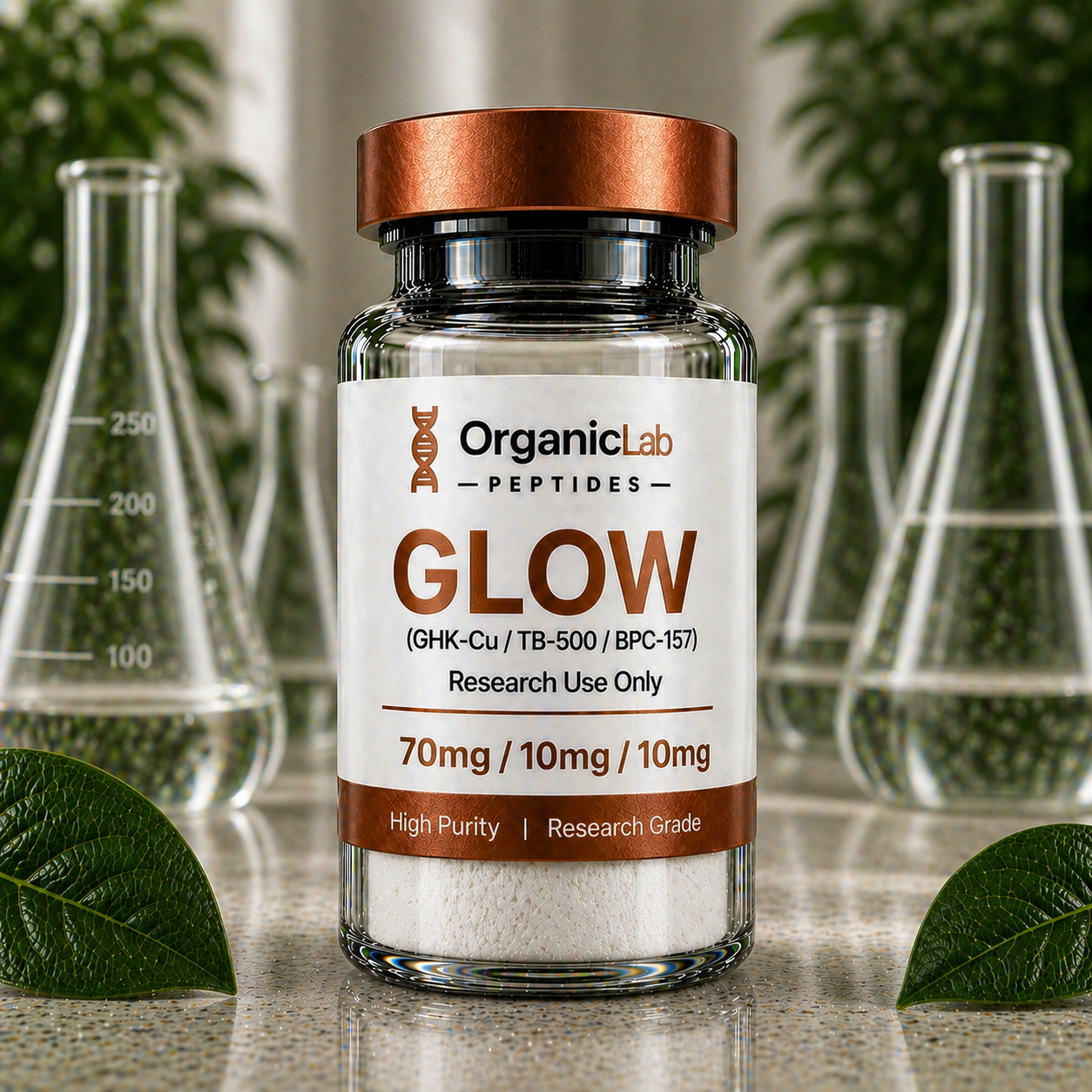
Synergistic Regenerative Blend
Three Mechanistically Distinct Peptides in One Research Formulation
GLOW brings together GHK-Cu, TB-500, and BPC-157 — three peptides with well-characterized but non-overlapping roles in tissue repair and regeneration. Rather than requiring separate compounds to address each phase of the healing cascade, GLOW consolidates them into a single formulation, enabling researchers to study their combined and potentially synergistic effects within a streamlined protocol.
- Triple-peptide blend: GHK-Cu + TB-500 + BPC-157
- Three distinct repair pathways engaged simultaneously
- Collagen synthesis, cell migration, and vascular repair in one formulation
- Simplified administration compared to three separate compounds
- High stability suitable for extended research cycles
For laboratory research use only. Not for human consumption.

Triple-Mechanism Action
Genomic Regulation, Cell Motility and Vascular Repair Acting in Concert
Each compound in GLOW operates through a distinct biological mechanism. GHK-Cu functions as a broad genomic modulator, influencing the expression of genes governing tissue growth, collagen deposition, and anti-inflammatory responses including suppression of NF-κB activity. TB-500 acts on actin dynamics to facilitate directional cell migration and cytoskeletal remodeling, enabling fibroblasts and endothelial cells to populate injury sites efficiently. BPC-157 enhances growth factor receptor activity and nitric oxide signaling, supporting microvascular perfusion and the early vascular response to tissue damage.
- GHK-Cu: Gene-level regulation of collagen synthesis and inflammatory markers
- TB-500: Actin-mediated cell migration, angiogenesis, and anti-apoptotic signaling
- BPC-157: Growth factor pathway activation and microcirculation support
- Convergent anti-inflammatory activity across all three compounds
- Coordinated support for organized wound healing and tissue remodeling
For laboratory research use only. Not for human consumption.

Multi-Tissue Applications
Orthopedic, Dermal and Gastrointestinal Repair Research
A key characteristic of GLOW is its applicability across diverse tissue types. The mechanistic breadth of its three components supports research in musculoskeletal repair (tendons, ligaments, muscle), dermal regeneration (wound healing, extracellular matrix remodeling), and gastrointestinal integrity (gut lining repair, mucosal protection) — making it a versatile platform for investigators working across multiple tissue systems.
- Tendon, ligament, and skeletal muscle repair modeling
- Wound healing kinetics and skin regeneration studies
- Gastrointestinal mucosal integrity and lining repair research
- Bone and connective tissue investigation
- Anti-fibrotic mechanisms and scar tissue reduction
- Comparative studies: triple blend vs. single-peptide protocols
For laboratory research use only. Not for human consumption.

GLOW: The Scientific Rationale for a Triple-Pathway Regenerative Blend
GLOW is built on the premise that effective tissue repair involves multiple parallel biological processes — and that studying them in combination reveals dynamics that single-compound protocols cannot. By pairing GHK-Cu, TB-500, and BPC-157 in one formulation, it allows researchers to investigate how genomic regulation, cellular motility, and vascular repair interact when activated simultaneously rather than sequentially.
GHK-Cu is a copper-binding tripeptide with a documented capacity to modulate a broad network of genes associated with tissue remodeling, collagen production, and oxidative stress defense. Its influence on NF-κB activity positions it as a regulator of the inflammatory microenvironment — shaping the conditions under which the other two peptides operate. TB-500 contributes the cytoskeletal dimension: by sequestering G-actin monomers and directing their polymerization, it enables the directed cell movement that populates wound beds with fibroblasts, endothelial cells, and progenitor populations. Without effective cell migration, the matrix synthesis signals from GHK-Cu and the vascular support from BPC-157 have fewer cells to act on.
BPC-157 addresses the vascular and trophic layer of repair. Through activation of growth factor receptor pathways and modulation of nitric oxide production, it supports the microvascular remodeling that supplies oxygen and nutrients to healing tissue. Its cytoprotective properties are also relevant to gastrointestinal research, where mucosal integrity depends on rapid epithelial turnover and adequate perfusion.
For research teams investigating multi-tissue regeneration, wound healing biology, or the pharmacological interactions between repair peptides, GLOW offers a single, well-characterized three-compound platform with independent preclinical literature supporting each component and a coherent biological rationale for their combination.
For research use only. Not for human consumption.