

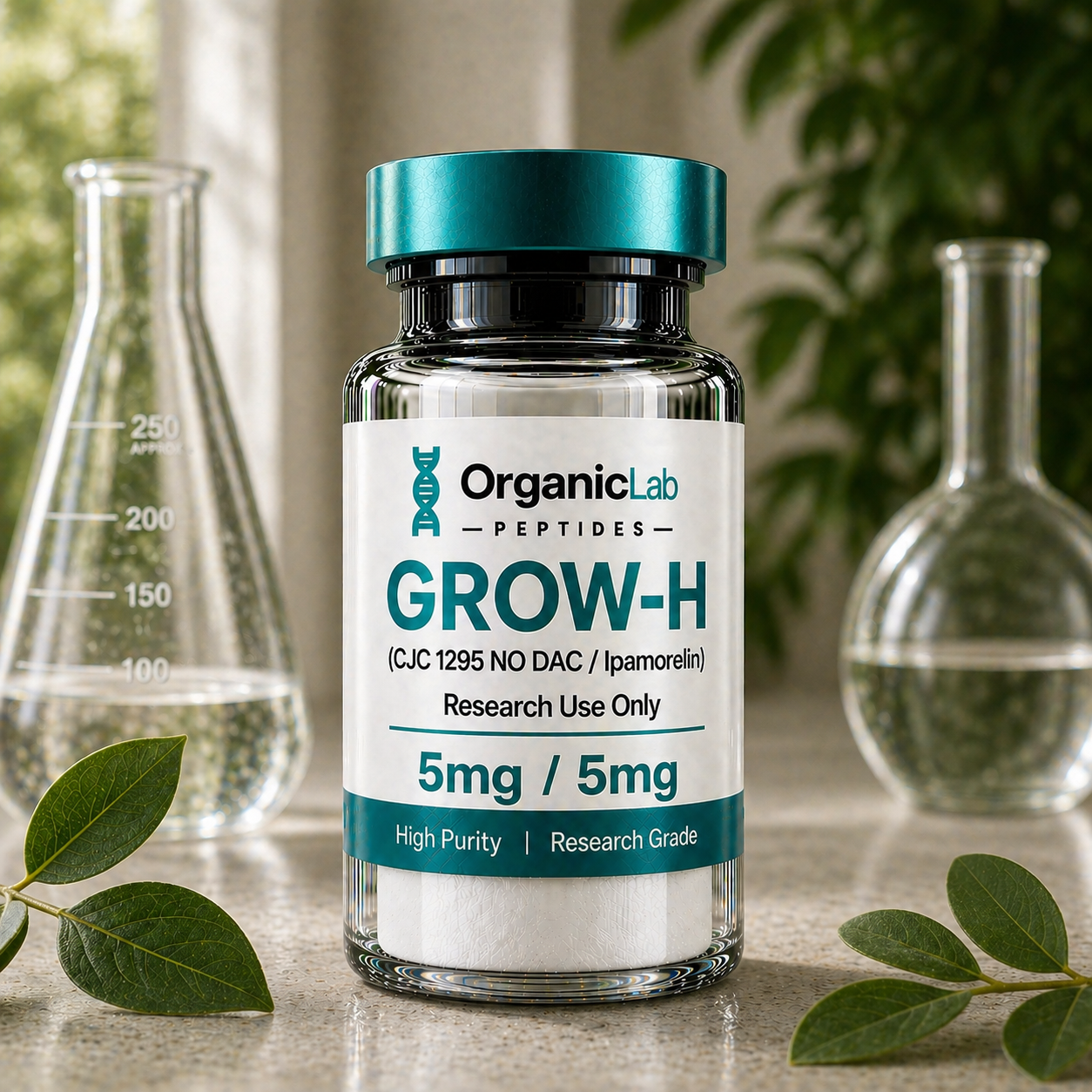
Dual GH Secretagogue Blend
Two Distinct Receptor Pathways for Growth Hormone Axis Research
This research blend combines CJC-1295 (No DAC) and Ipamorelin — two peptides that engage different receptor systems involved in growth hormone secretion. CJC-1295 acts on pituitary GHRH receptors, while Ipamorelin targets the ghrelin/GHS receptor through a separate and independent mechanism. Used together, they engage the GH axis at two distinct points simultaneously, producing effects that go beyond what either compound achieves in isolation.
- 10mg total: CJC-1295 (5mg) + Ipamorelin (5mg)
- Dual-pathway GH stimulation via GHRH and ghrelin receptors
- Complementary mechanisms producing additive effects
- Preserves pulsatile GH secretion patterns
- No DAC formulation suited for controlled research timelines
For laboratory research use only. Not for human consumption.

Complementary Mechanisms
GHRH and Ghrelin Receptor Activation: Independent Pathways, Shared Outcome
CJC-1295 is a modified analog of growth hormone-releasing hormone that binds pituitary GHRH receptors, replicating the signaling cascade initiated by the body's own GHRH. Ipamorelin operates through an entirely separate route — it is a selective agonist of the ghrelin/GHS receptor, with a specificity profile that minimizes off-target hormonal effects. Because they engage different receptor populations, the two peptides can be studied in combination without mechanistic overlap, making this blend particularly useful for GH axis research requiring dual-pathway activation.
- CJC-1295: GHRH receptor agonist acting on pituitary somatotrophs
- Ipamorelin: Selective ghrelin/GHS receptor agonist
- Ipamorelin elevates baseline GH secretion
- CJC-1295 amplifies peak output and trough levels
- Combined effect preserves natural pulsatile GH rhythm
For laboratory research use only. Not for human consumption.

Research Applications
GH Axis Modeling, Bone Metabolism and Body Composition Research
The CJC-1295/Ipamorelin combination supports research across the broad range of physiological processes regulated by the GH axis. Ipamorelin's documented activity includes effects on bone mineral density, pancreatic insulin secretion, gastric motility, and muscle tissue in preclinical models. CJC-1295 adds the capacity to study GH restoration in deficiency models, making this blend a versatile platform for investigating how GH axis modulation influences systemic physiology.
- Bone mineral density and skeletal metabolism research
- Muscle repair, hypertrophy and lean mass modeling
- Pancreatic insulin secretion and metabolic function
- Gastric motility and postoperative bowel function studies
- Body composition and fat-to-lean ratio investigation
- GH deficiency and axis restoration modeling
For laboratory research use only. Not for human consumption.

CJC-1295 + Ipamorelin: Rationale for a Dual-Receptor GH Research Blend
The CJC-1295/Ipamorelin blend is built around a straightforward pharmacological rationale: the two peptides engage non-overlapping receptor systems within the GH secretion pathway, making their combination a genuine dual-pathway approach rather than simple redundancy. Each compound contributes distinct and documented effects to the overall GH secretory profile.
CJC-1295 (No DAC) is a truncated, stabilized GHRH analog. By binding pituitary GHRH receptors, it amplifies GH release in a pattern that mirrors — rather than disrupts — the body's natural secretory rhythm. The absence of a Drug Affinity Complex keeps its half-life shorter and better suited to protocols requiring temporal control. Preclinical studies have demonstrated its capacity to normalize growth in GHRH-deficient models without abolishing the pulsatile dynamics characteristic of healthy GH physiology.
Ipamorelin is one of the most receptor-selective GH secretagogues characterized to date. Its affinity for the ghrelin/GHS receptor is high, while its influence on cortisol, prolactin, and other pituitary hormones is minimal — a profile that simplifies interpretation in research settings. Documented preclinical effects include improvements in bone mineral content, counteraction of glucocorticoid-induced bone loss, stimulation of pancreatic insulin release, and enhanced gastric contractility in ileus models.
In combination, these two peptides establish an elevated baseline of GH secretory activity through Ipamorelin's tonic receptor engagement, while CJC-1295 amplifies both peak output and inter-pulse troughs. For research teams studying GH axis regulation, metabolic physiology, bone biology, or body composition, this blend provides a well-characterized, dual-pathway tool with independent preclinical support for each component.
For research use only. Not for human consumption.