

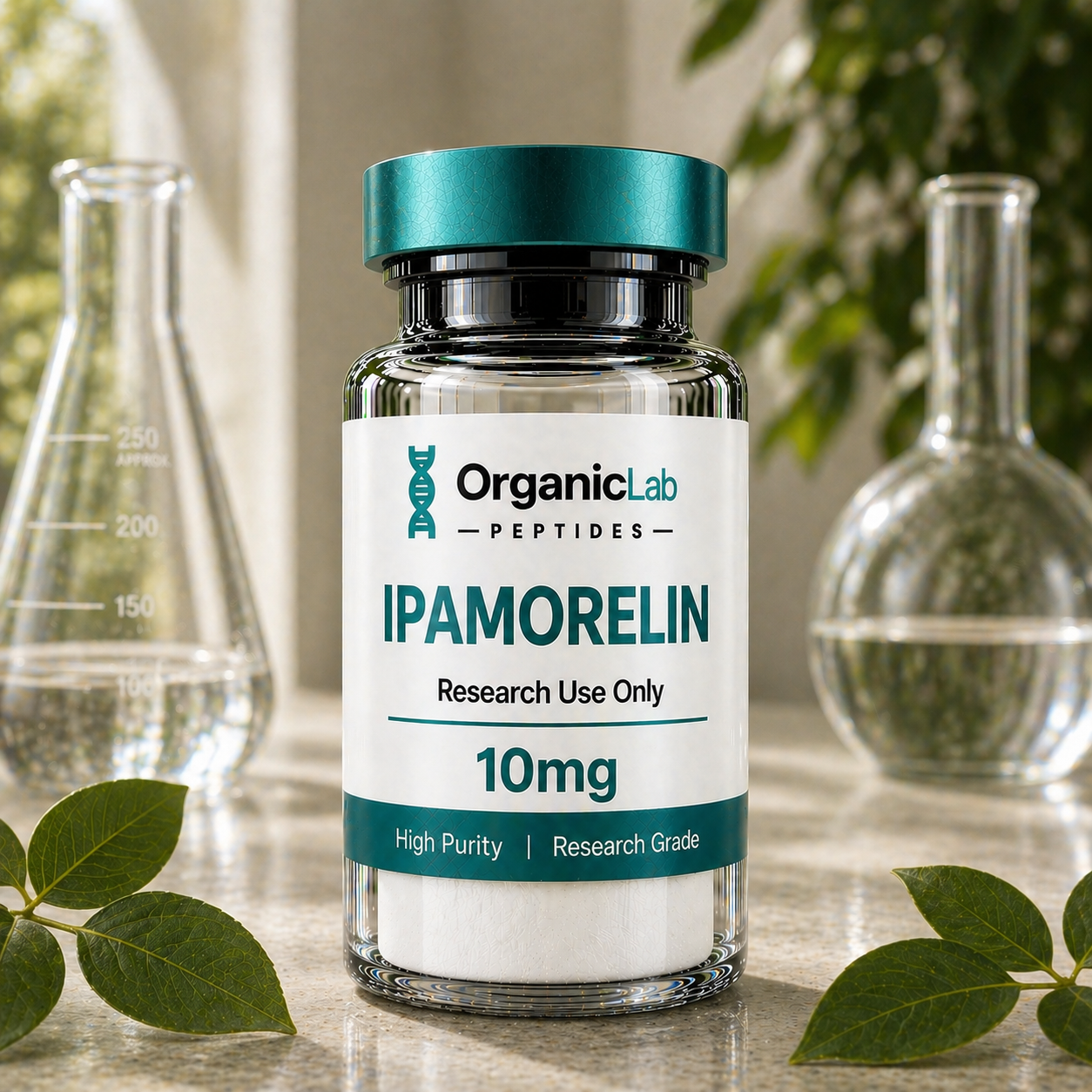
Selective GH Secretagogue
Receptor-Selective GH Stimulation Without Neuroendocrine Off-Target Effects
Ipamorelin is a synthetic pentapeptide agonist of the ghrelin receptor (GHSR-1a) developed to stimulate growth hormone secretion with a high degree of target selectivity. In contrast to earlier-generation growth hormone releasing peptides, Ipamorelin produces a pulsatile GH response without measurable effects on ACTH, cortisol, prolactin, FSH, LH, or TSH — a profile that considerably simplifies experimental interpretation and expands its utility for chronic research protocols.
- Pentapeptide sequence: Aib-His-D-2Nal-D-Phe-Lys-NH₂
- High-affinity GHSR-1a agonist with narrow receptor selectivity
- No measurable effect on cortisol, ACTH, prolactin, or gonadotropins
- Pulsatile GH release peaking around 40 minutes post-administration
- Terminal half-life approximately 2 hours; returns to baseline
For laboratory research use only. Not for human consumption.

Precision GH Signaling
GHSR-1a Activation Without Broader Pituitary Stimulation
Ipamorelin's selectivity distinguishes it mechanistically from older GHRPs. By activating GHSR-1a on pituitary somatotrophs, it amplifies GH release through two complementary actions: potentiating the endogenous GHRH signaling pathway and attenuating somatostatin-mediated inhibitory tone. The result is a brief, physiologically patterned GH pulse rather than a sustained or dysregulated hormonal elevation. Crucially, preclinical studies demonstrated no ACTH or cortisol response even at doses exceeding 200 times the GH-effective dose — a level of neuroendocrine selectivity not observed with GHRP-6 or hexarelin.
- GHSR-1a activation on pituitary somatotroph cells
- Potentiates endogenous GHRH signaling pathway
- Attenuates somatostatin inhibitory tone on GH release
- No ACTH/cortisol response at doses exceeding 200× GH ED50
- Significantly cleaner neuroendocrine profile than earlier GHRPs
For laboratory research use only. Not for human consumption.

Research Applications
Bone Metabolism, Muscle Preservation and Diagnostic Imaging Research
Preclinical investigation of Ipamorelin spans a broad range of physiological applications. Its documented effects include the capacity to counteract glucocorticoid-induced bone loss, support positive nitrogen balance in catabolic states, modulate pancreatic insulin secretion, and accelerate gastrointestinal recovery following surgical intervention. Its high and selective receptor affinity additionally makes it a candidate for radiolabeled diagnostic applications targeting GHSR-1a expression in oncology and cardiac research.
- Bone metabolism: Counteracts steroid-induced bone mineral loss
- Muscle preservation: Improves nitrogen balance in catabolic models
- Metabolic research: Modulates pancreatic insulin secretion
- GI research: Accelerates post-surgical gastrointestinal recovery
- Diagnostic imaging: Radiolabeled probe for GHSR-1a expression mapping
For laboratory research use only. Not for human consumption.

Ipamorelin: A Reference Compound for Selective GH Receptor Research
Ipamorelin was developed to address a key limitation of earlier growth hormone secretagogues: the inability to stimulate GH release without simultaneously activating other pituitary axes. As a pentapeptide ghrelin receptor agonist, it achieves GH stimulation through highly specific GHSR-1a engagement, producing a short-duration pulsatile response that mirrors endogenous secretory patterns rather than overriding them.
The selectivity data is particularly notable. Earlier GHRPs — including GHRP-6 and hexarelin — produce dose-dependent elevations in cortisol and ACTH, complicating experimental designs that aim to isolate GH-specific effects. Ipamorelin, by contrast, showed no detectable ACTH or cortisol response in animal studies even at doses far exceeding those required for GH stimulation. This absence of neuroendocrine spillover makes it considerably more tractable for protocols that require clean separation of GH axis effects from adrenal or stress-related variables.
Preclinical research has documented meaningful activity across several tissue systems. In glucocorticoid-treated animal models, Ipamorelin produced substantial improvements in bone formation rates and systemic bone mineral density — findings relevant to research on steroid-induced osteopenia. In nitrogen balance studies, it attenuated muscle catabolism associated with catabolic stress. In metabolic models, it potentiated insulin release through an indirect mechanism involving pancreatic calcium channel activity. In gastrointestinal research, it reduced recovery time following surgical ileus.
Its high receptor affinity and structural stability also support use as a radiolabeled imaging probe for mapping GHSR-1a expression — applicable to cancer biology, where ghrelin receptors are frequently upregulated, and to cardiovascular research. For teams studying GH axis pharmacology, musculoskeletal biology, metabolic function, or receptor imaging, Ipamorelin provides a well-characterized, highly selective tool with a broad and growing preclinical evidence base.
For research use only. Not for human consumption.