

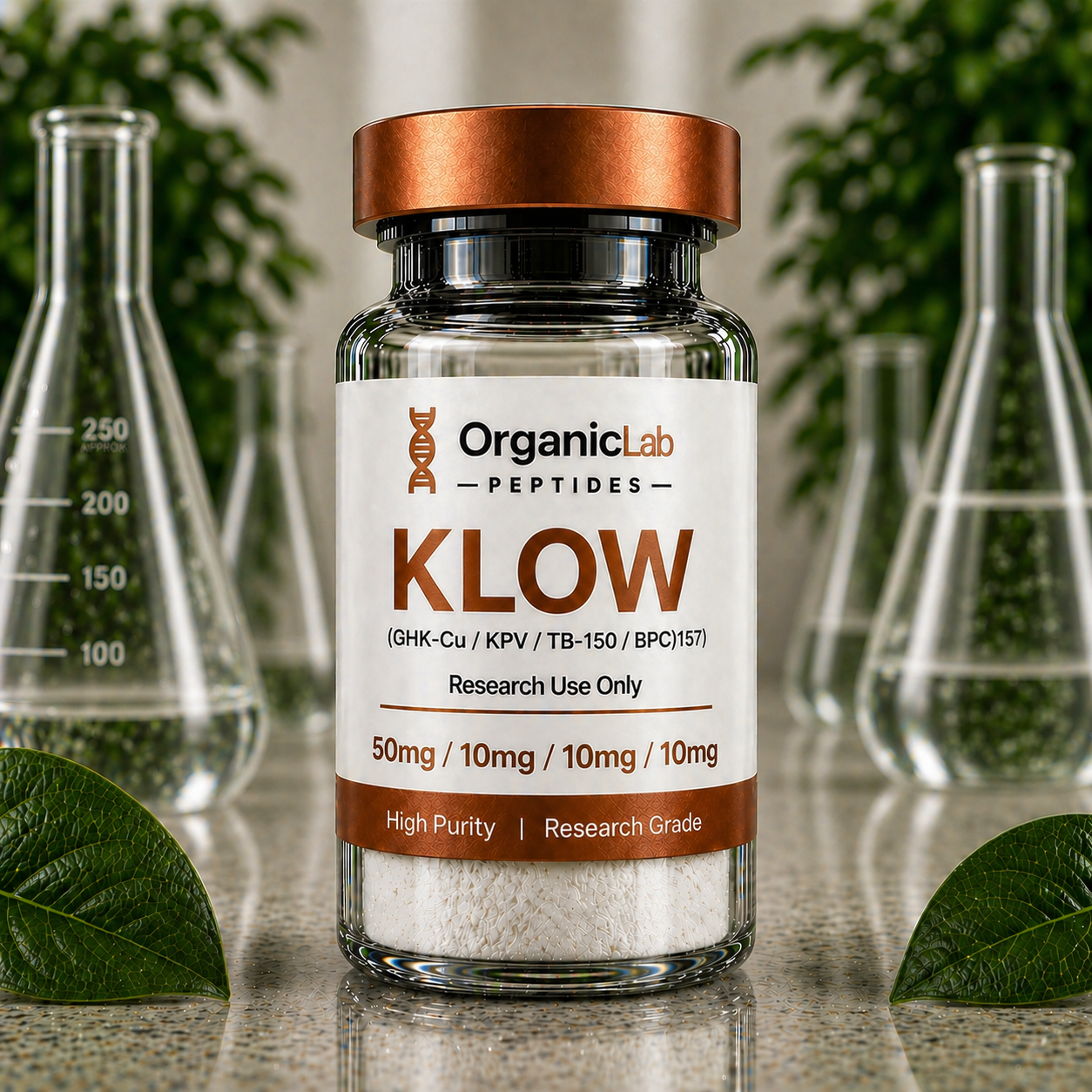
Advanced Quad-Peptide Blend
Four Compounds, Four Mechanisms: A Comprehensive Regenerative Research Platform
KLOW is a quad-peptide research formulation combining BPC-157, TB-500, KPV, and GHK-Cu in a single vial. Each compound addresses a distinct phase of the tissue repair and regeneration cascade — vascular remodeling, cellular migration, immune modulation, and matrix synthesis — making KLOW a tool for researchers who need to study multiple repair pathways simultaneously without managing four separate compounds.
- Quad-peptide blend: BPC-157 + TB-500 + KPV + GHK-Cu
- 80mg total peptide content (10mg + 10mg + 10mg + 50mg)
- Four mechanistically distinct and complementary repair pathways
- KPV addition provides dedicated anti-inflammatory and antimicrobial coverage
- Simplified protocol versus sourcing and combining four individual compounds
For laboratory research use only. Not for human consumption.

Quad-Mechanism Action
Each Peptide Targeting a Distinct Stage of the Healing Cascade
The four components of KLOW operate on non-overlapping biological targets. BPC-157 stimulates angiogenesis and growth factor signaling critical to early vascular repair. TB-500 — the complete 43-amino-acid Thymosin Beta-4 sequence — drives actin-dependent cell migration toward injury sites. KPV, a tripeptide fragment of α-melanocyte-stimulating hormone, suppresses pro-inflammatory cytokine activity and NF-κB signaling while also demonstrating antimicrobial properties. GHK-Cu acts at the genomic level, modulating the expression of genes involved in collagen synthesis and extracellular matrix organization.
- BPC-157: Angiogenesis, growth factor signaling, cytoprotection
- TB-500: Actin dynamics, directed cell migration, wound closure
- KPV: Pro-inflammatory cytokine suppression, NF-κB inhibition, antimicrobial activity
- GHK-Cu: Gene-level regulation of collagen and matrix remodeling
- Coordinated activity spanning all major phases of tissue repair
For laboratory research use only. Not for human consumption.

Research Applications
Inflammatory Conditions, Gut Integrity and Multi-Tissue Regeneration Studies
KLOW is particularly well-suited for research designs where inflammatory control and tissue repair must be studied in parallel. The inclusion of KPV extends its applicability beyond structural repair into research on gut barrier function, autoimmune pathways, and infection-associated tissue damage — areas where inflammation and regeneration are deeply intertwined and benefit from being studied together rather than in isolation.
- Inflammatory and autoimmune pathway research
- Gastrointestinal barrier integrity and gut healing studies
- Tendon, ligament, and skeletal muscle repair modeling
- Wound healing kinetics and dermal regeneration research
- Antimicrobial peptide activity and infection-associated repair
- Comparative studies: quad vs. triple vs. dual vs. single peptide protocols
For laboratory research use only. Not for human consumption.

KLOW: The Scientific Rationale for a Four-Compound Regenerative Blend
KLOW is structured around the principle that tissue repair is not a single-pathway event but a coordinated cascade involving vascular remodeling, cellular recruitment, immune regulation, and matrix synthesis. By assembling four peptides with independent, non-redundant mechanisms into one formulation, KLOW allows researchers to investigate how these processes interact when activated simultaneously — a question that cannot be answered with single-compound protocols.
BPC-157 contributes to the vascular and trophic dimension of repair: it promotes new blood vessel formation through angiogenic signaling, supports fibroblast activity, and protects epithelial and mucosal tissue. TB-500 addresses the cytoskeletal and migratory dimension: by sequestering G-actin and directing filament assembly, it enables repair cells to move efficiently toward sites of damage, while also supporting endothelial cell organization during vascular remodeling.
KPV targets the inflammatory dimension — a phase that, when dysregulated, actively impairs the repair processes that the other compounds support. As a C-terminal tripeptide of α-MSH, KPV inhibits pro-inflammatory cytokine release and NF-κB activation, dampening the immune response without abolishing it. It also displays direct antimicrobial activity, making it particularly relevant to research models where microbial burden or gut permeability is a variable. GHK-Cu operates at the genomic level, modulating the expression of a broad network of genes associated with collagen production, anti-fibrotic remodeling, and antioxidant defense.
For research teams studying multi-phase tissue repair, inflammatory resolution, gut biology, or the pharmacology of peptide combinations, KLOW provides a single, well-characterized formulation that spans the full spectrum of the healing cascade — from initial vascular response through immune modulation to organized matrix deposition.
For research use only. Not for human consumption.