

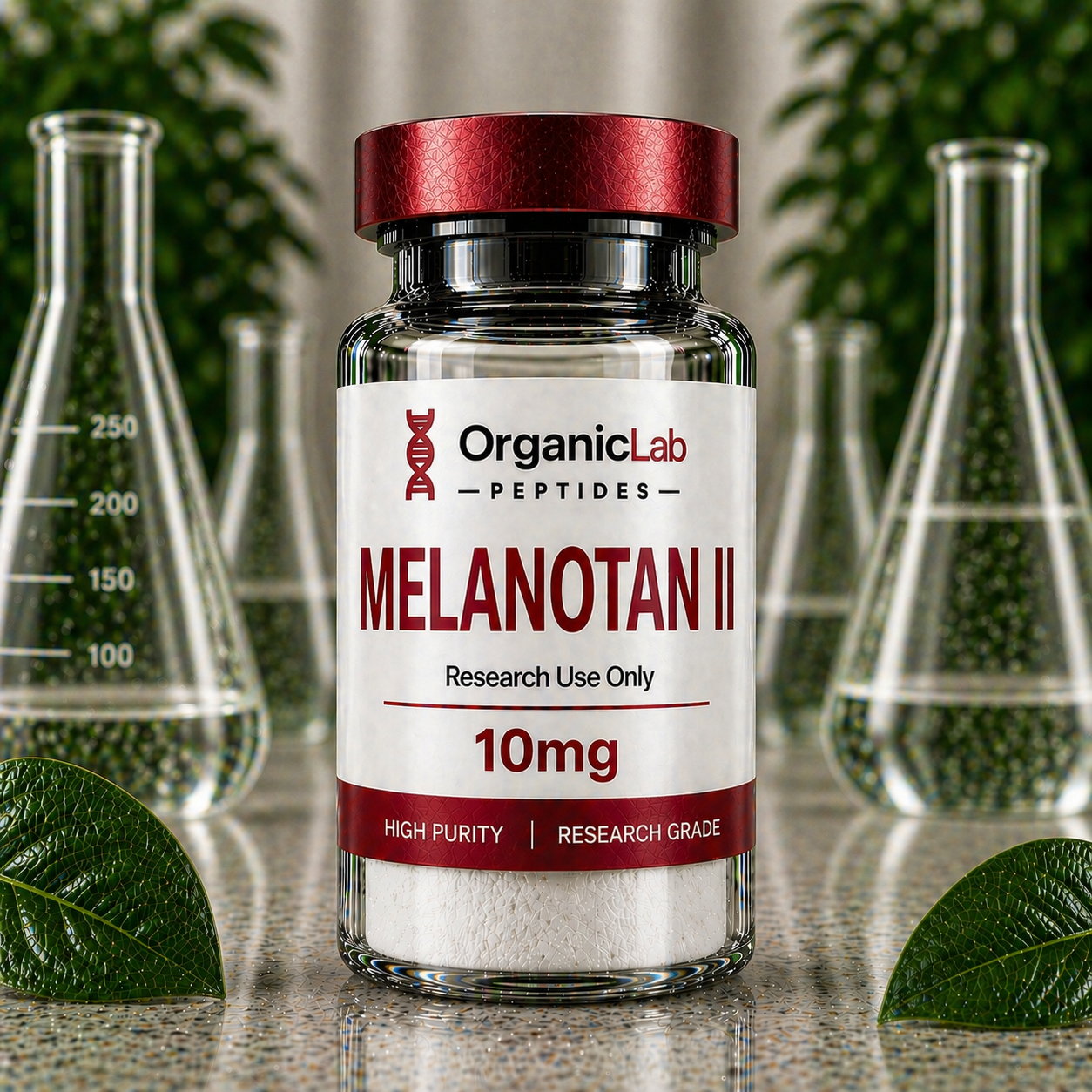
Melanocortin Receptor Agonist
A Stabilized α-MSH Analog for Melanocortin Receptor Research
Melanotan II is a synthetic cyclic heptapeptide derived from the structure of α-melanocyte-stimulating hormone (α-MSH). Its cyclized architecture confers greater metabolic stability and prolonged receptor engagement compared to the linear native hormone, making it a practical tool for research into melanocortin receptor biology. Its activity spans multiple receptor subtypes — particularly MC1R and MC4R — enabling investigation of both pigmentation mechanisms and neuroendocrine signaling pathways within a single compound.
- Synthetic cyclic analog of α-melanocyte-stimulating hormone
- Engages MC1R (pigmentation) and MC4R (neuroendocrine signaling)
- Cyclic heptapeptide structure for improved stability and binding duration
- Developed as a research tool for melanocortin system investigation
- High purity for consistent and reproducible experimental outcomes
For laboratory research use only. Not for human consumption.

Melanocortin Signaling
MC1R and MC4R Activation: Pigmentation and Beyond
Melanotan II exerts its effects by binding to melanocortin receptors expressed on melanocytes and in the central nervous system. Engagement of MC1R initiates a cAMP-dependent signaling cascade within melanocytes, stimulating the production and distribution of eumelanin — the dark pigment governing skin and hair coloration. Parallel activity at MC4R, which is expressed predominantly in hypothalamic regions, has generated research interest in appetite regulation, energy homeostasis, and broader neuroendocrine control mechanisms.
- MC1R activation on melanocytes triggers eumelanin biosynthesis
- cAMP-dependent intracellular signaling cascade
- Stimulates dark pigment production in skin and hair follicles
- MC4R activity links to appetite and energy regulation research
- Cyclized structure prolongs receptor occupancy vs. linear α-MSH
For laboratory research use only. Not for human consumption.

Research Applications
Pigmentation Biology, Receptor Pharmacology and Neuroendocrine Research
Melanotan II is used across research contexts where investigation of the melanocortin receptor system is the primary objective. Its multi-subtype activity profile makes it relevant to studies spanning melanogenesis, receptor selectivity characterization, feeding behavior, and photoprotective mechanisms — areas where the interaction between skin biology and central neuroendocrine signaling is under active investigation.
- Melanogenesis and pigmentation pathway studies
- Melanocortin receptor subtype characterization (MC1R vs. MC4R)
- Appetite regulation and feeding behavior research
- Neuroendocrine signaling and hypothalamic pathway exploration
- Receptor selectivity and agonist binding studies
- Photoprotective mechanism and UV response research
For laboratory research use only. Not for human consumption.

Melanotan II: A Research Tool for the Melanocortin System
Melanotan II is a synthetic cyclic heptapeptide designed to engage the melanocortin receptor family with greater stability and sustained activity compared to the endogenous ligand α-MSH. Its cyclized structure prevents the rapid enzymatic degradation that limits the research utility of linear peptides, making it well-suited for protocols requiring reproducible receptor activation over extended timeframes.
The compound's primary documented mechanism involves MC1R activation on melanocytes. Upon receptor binding, it initiates a cAMP-mediated intracellular cascade that upregulates tyrosinase activity and shifts melanin production toward eumelanin — the high-molecular-weight dark pigment that determines coloration in skin and hair. This pathway is central to research on melanogenesis, photoprotection, and the cellular biology of pigment-producing cells.
Activity at MC4R, concentrated in hypothalamic nuclei, has directed a separate line of investigation toward neuroendocrine function. MC4R is known to participate in the regulation of food intake, energy expenditure, and autonomic output — making Melanotan II relevant to researchers examining how central melanocortin signaling interfaces with metabolic and behavioral physiology. Its multi-receptor profile also makes it a useful comparator in studies designed to parse receptor subtype contributions to observed biological effects.
For research teams working on pigmentation biology, melanocortin receptor pharmacology, neuroendocrine regulation, or photoprotective mechanisms, Melanotan II provides a chemically stable, well-characterized research compound supported by a substantial body of scientific literature spanning receptor binding, cellular signaling, and in vivo pigmentation studies.
For research use only. Not for human consumption.