

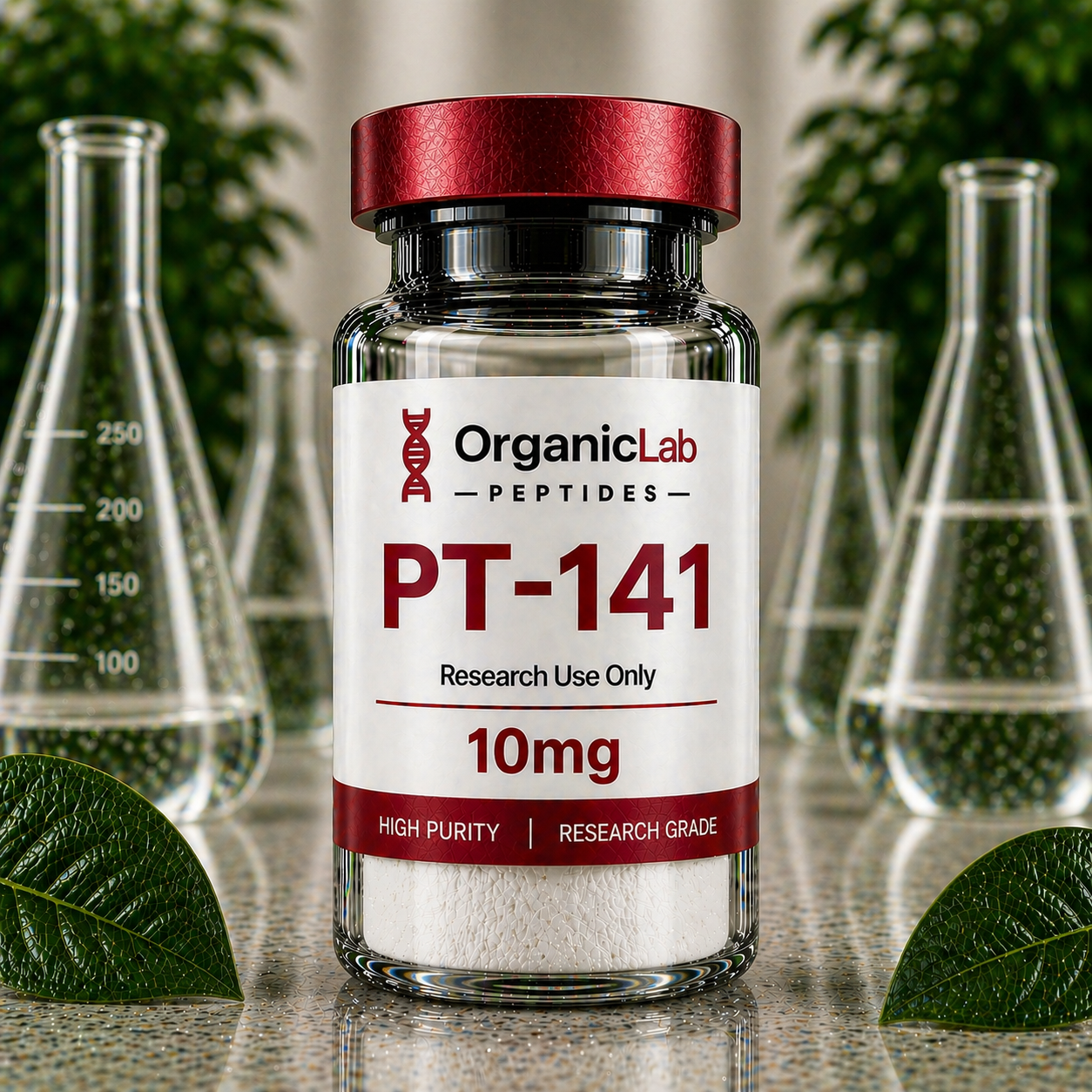
Melanocortin Receptor Agonist
A Central Nervous System Approach to Arousal Research
PT-141 (Bremelanotide) is a synthetic cyclic heptapeptide derived from the α-MSH analog Melanotan II, designed to activate melanocortin receptors MC4R and MC1R within the central nervous system. Its mechanism is fundamentally different from PDE5 inhibitors, which act peripherally on vascular smooth muscle: PT-141 engages hypothalamic arousal circuits directly, addressing the neurological dimension of sexual desire rather than its vascular downstream effects. This distinction has made it relevant both to subjects who respond poorly to conventional approaches and to broader research on melanocortin system neurobiology.
- Cyclic heptapeptide: Ac-Nle-c[Asp-His-DPhe-Arg-Trp-Lys]-NH₂
- Activates MC4R (central arousal circuits) and MC1R (immune/repair)
- Acts via CNS pathways — distinct from peripheral vascular mechanisms
- Documented efficacy in subjects non-responsive to PDE5 inhibitors
- FDA-approved for hypoactive sexual desire disorder (HSDD)
For laboratory research use only. Not for human consumption.

MC4R Pathway Research
Hypothalamic MC4R Activation and Multi-Receptor Signaling
PT-141 exerts its primary effects through melanocortin-4 receptor (MC4R) engagement in hypothalamic nuclei that regulate sexual behavior, energy balance, and autonomic output. This receptor population is pharmacologically distinct from the vascular targets of traditional sexual dysfunction compounds, explaining PT-141's documented activity in cases where vascular-focused approaches have failed. A secondary mechanism involves MC1R activation, a receptor with well-characterized roles in immune cell polarization, inflammatory resolution, and DNA damage repair — extending the compound's research relevance well beyond its primary indication.
- MC4R engagement in hypothalamic sexual arousal and desire circuits
- Modulates appetite and energy homeostasis pathways via MC4R
- Autonomic arousal through central rather than peripheral mechanisms
- MC1R: Immune modulation, macrophage polarization, DNA repair stimulation
- Dual-receptor activity supports multi-system research applications
For laboratory research use only. Not for human consumption.

Expanding Research Applications
Sexual Function, Tissue Protection, Immunity and Oncology Research
The research profile of PT-141 extends across several domains beyond its primary sexual function application. Its MC1R activity has generated interest in inflammation and immune function research, with studies documenting anti-fungal and anti-inflammatory effects mediated through macrophage polarization. Modified PT-141 derivatives have been evaluated in hemorrhagic shock models, demonstrating tissue-protective effects during hypovolemic stress. MC1R's role in nucleotide excision repair pathways has also positioned PT-141 derivatives as tools for investigating UV-related DNA damage and skin cancer susceptibility.
- Sexual dysfunction: Male and female desire pathway research
- Hemorrhagic shock: Tissue protection and ischemia reduction studies
- Immune research: MC1R-mediated anti-fungal and anti-inflammatory effects
- Cancer biology: MC1R stimulation of DNA repair and skin carcinoma research
- Obesity: MC4R involvement in early-onset metabolic dysfunction models
For laboratory research use only. Not for human consumption.

PT-141: Central Melanocortin Signaling for Sexual Function and Beyond
PT-141 (Bremelanotide) is a cyclic heptapeptide that engages the melanocortin receptor system at the level of the central nervous system, bypassing the vascular mechanisms targeted by conventional sexual dysfunction pharmacology. This central mode of action — operating through hypothalamic MC4R signaling rather than penile or genital blood flow — accounts for its documented activity in populations where PDE5 inhibitors have been ineffective, and positions it as a distinct research tool for studying desire as a neurological rather than purely vascular phenomenon.
Clinical Phase 3 data from the RECONNECT trials demonstrated statistically significant improvements in desire and distress endpoints in premenopausal women with hypoactive sexual desire disorder — outcomes that supported FDA approval in 2019. In male subjects with erectile dysfunction who had not responded to sildenafil, approximately one-third achieved adequate erectile function with PT-141, with dose-dependent response patterns consistent with receptor-mediated activity. These findings confirm that MC4R-driven arousal pathways represent a pharmacologically accessible and clinically meaningful target.
The MC4R system extends beyond sexual function into appetite regulation and energy homeostasis — areas where MC4R loss-of-function variants have been linked to a meaningful proportion of early-onset obesity cases. This overlap positions PT-141 as a useful research tool for investigators studying the intersection of reproductive neurobiology and metabolic regulation within the same receptor system.
MC1R activation adds a further research dimension. This receptor's involvement in immune cell polarization, inflammatory modulation, and nucleotide excision repair makes it relevant to studies on infection response, UV-induced DNA damage, and melanoma biology. Modified analogs have been tested in hemorrhagic shock models, demonstrating protective effects on ischemic tissue during hypovolemic conditions. For teams investigating melanocortin receptor pharmacology, sexual function neurobiology, immune modulation, tissue protection, or oncology-adjacent DNA repair pathways, PT-141 provides a multi-receptor research compound with an established clinical validation record.
For research use only. Not for human consumption.