

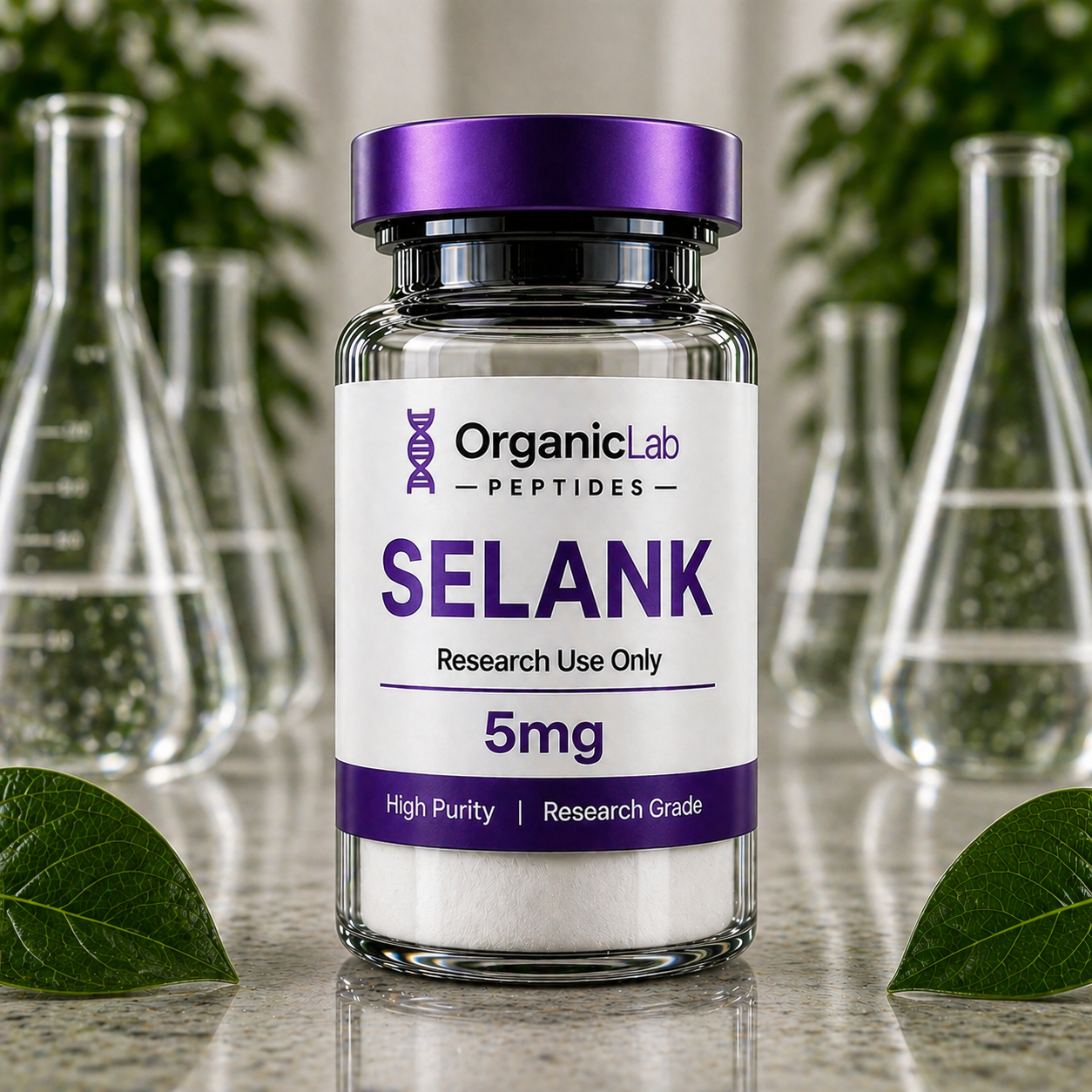
Anxiolytic Heptapeptide
A Tuftsin-Derived Peptide with Anxiolytic and Cognitive Properties
Selank is a synthetic heptapeptide analog of tuftsin (sequence: Thr-Lys-Pro-Arg-Pro-Gly-Pro) engineered with a C-terminal glyproline extension that substantially improves its metabolic stability compared to the parent compound. In controlled clinical trials for generalized anxiety, it demonstrated anxiolytic efficacy comparable to established benzodiazepine-class compounds while simultaneously producing anti-asthenic and mild psychostimulant effects — a profile that stands in marked contrast to the sedation and cognitive suppression associated with conventional anxiolytics.
- Heptapeptide sequence: Thr-Lys-Pro-Arg-Pro-Gly-Pro (TKPRPGP)
- Tuftsin analog with glyproline motif for enhanced metabolic stability
- Anxiolytic efficacy documented against benzodiazepine comparators
- No sedation, amnesia, tolerance, or withdrawal observed in studies
- Anti-asthenic properties — associated with improved alertness rather than sedation
For laboratory research use only. Not for human consumption.

Multi-Axis Mechanism
GABA Gene Modulation, BDNF Upregulation and Enkephalinase Inhibition
Selank's anxiolytic activity arises from a mechanistically distinct approach to GABAergic regulation. Rather than acting as a direct GABA receptor agonist — the mechanism that produces tolerance and sedation with benzodiazepines — Selank modulates the expression of genes governing GABA receptor subunit composition, shifting receptor affinity without direct agonism. Concurrently, it increases hippocampal BDNF levels following intranasal administration, supporting neuroplasticity alongside its anxiolytic effects. A third mechanism involves inhibition of enkephalin-degrading enzymes, which prolongs the activity of endogenous opioid peptides involved in stress attenuation and pain modulation.
- Modulates expression of genes governing GABA receptor subunit composition
- Increases BDNF in the hippocampus following intranasal administration
- Inhibits enkephalinases — extends half-life of endogenous stress-relief peptides
- Regulates IL-6 and a broad network of inflammation-related genes
- Alters GABA receptor affinity through gene expression rather than direct agonism
For laboratory research use only. Not for human consumption.

Research Applications
Anxiety Biology, Memory Research and Neuroimmune Modulation
Selank's research applications extend well beyond classical anxiolysis. Memory studies have documented enhanced memory trace stability independent of its anxiety-reducing effects, suggesting intrinsic nootropic activity mediated through hippocampal gene regulation. Enkephalinase inhibition has drawn interest from pain researchers studying the preservation of endogenous analgesia. Its documented regulation of cytokine signaling pathways makes it relevant to neuroimmune research, and preclinical data has identified antiviral activity in influenza models.
- Anxiety and GABA pharmacology research
- Memory consolidation and hippocampal gene regulation studies
- Pain modulation: enkephalinase inhibition and endogenous analgesia
- Cognitive rescue following neurotoxic or ischemic insult
- Neuroimmune research: cytokine regulation and IL-6 pathway modulation
For laboratory research use only. Not for human consumption.

Selank: A Multi-Target Anxiolytic Peptide for Anxiety, Cognition and Neuroimmune Research
Selank is a stabilized synthetic heptapeptide derived from tuftsin, an endogenous immunomodulatory tetrapeptide. The addition of a glyproline (Pro-Gly-Pro) sequence to the tuftsin backbone significantly extends its metabolic half-life, enabling research protocols that would be impractical with the rapidly degraded parent molecule. This structural modification preserves and expands tuftsin's biological activity while adding anxiolytic and nootropic properties not present in the original peptide.
What distinguishes Selank mechanistically from conventional anxiolytics is how it engages the GABAergic system. Benzodiazepines produce their effects by directly enhancing GABA receptor activity — a mechanism that also causes sedation, amnesia, and, with repeated use, tolerance and physical dependence. Selank instead modulates the transcriptional regulation of GABA receptor subunit genes, altering receptor composition and affinity without acting as a direct agonist. This indirect approach appears to explain why Selank produces anxiolysis without the cognitive suppression or dependence profile associated with classical GABA-enhancing drugs.
Its concurrent effects on neurotrophin signaling add a second dimension to its research relevance. Intranasal Selank has been shown to increase hippocampal BDNF expression — positioning it alongside compounds like Semax in the study of neuroplasticity and cognitive function. Memory consolidation studies have documented improvements in trace stability that appear independent of anxiety reduction, suggesting a direct nootropic action rather than an indirect benefit from reduced stress interference. Enkephalinase inhibition — a third documented mechanism — preserves the activity of endogenous opioid peptides involved in pain attenuation and stress response.
For research teams investigating anxiety pharmacology, GABAergic signaling, cognitive enhancement, neuroimmune regulation, or the interaction between anxiety and memory, Selank provides a well-characterized, multi-target research compound with clinical validation data and a mechanistic profile that differs substantially from conventional anxiolytic drug classes.
For research use only. Not for human consumption.