

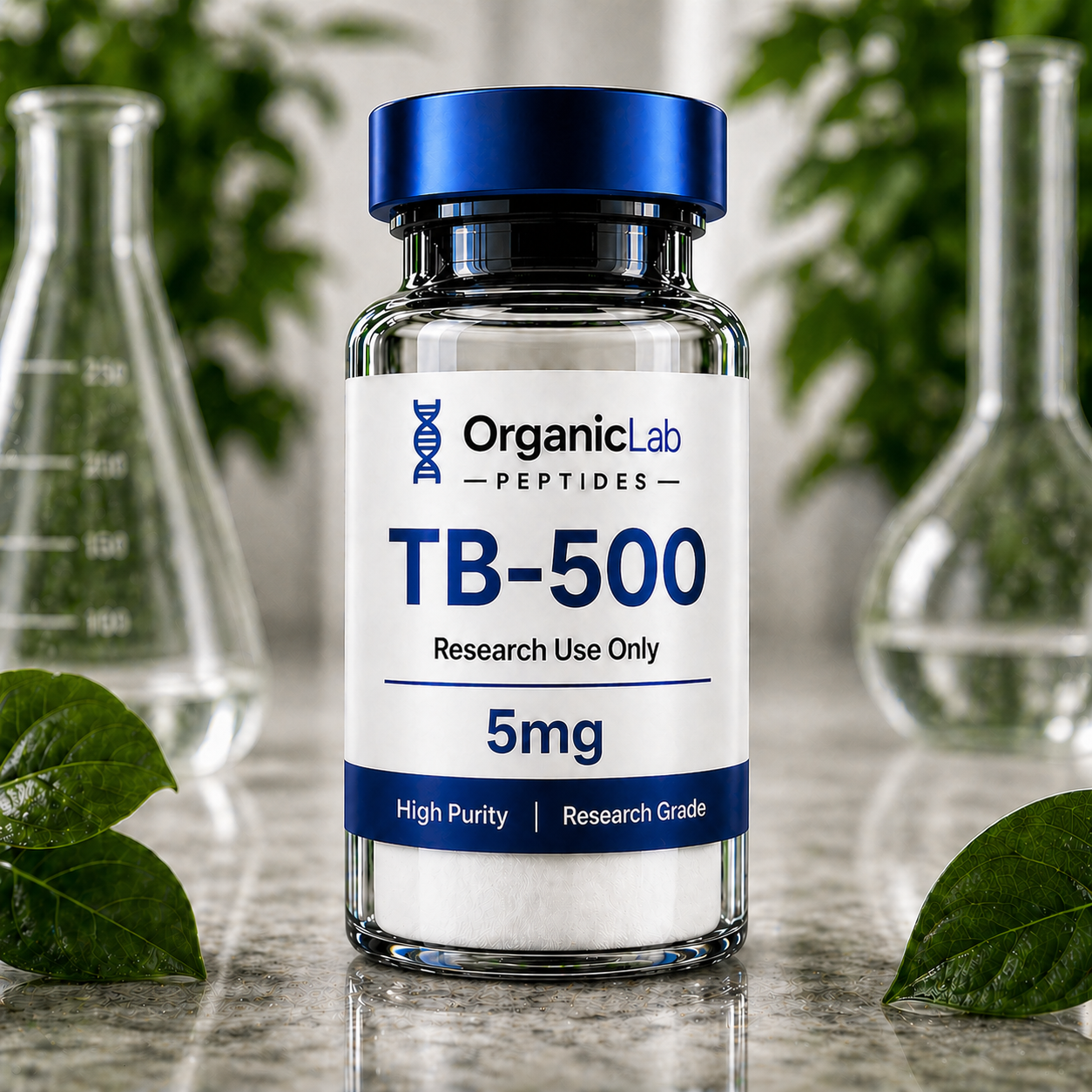
Full-Length Thymosin Beta-4
A Complete 43-Amino-Acid Sequence for Regenerative Research
TB-500 is a synthetic peptide replicating the full 43-amino-acid sequence of Thymosin Beta-4 — an endogenous protein involved in cellular repair and tissue maintenance. Providing the complete sequence rather than a truncated fragment preserves all functional domains, including those responsible for actin regulation, cell motility, and vascular development, giving researchers access to the full biological activity of this regenerative molecule.
- Complete 43-amino-acid Thymosin Beta-4 sequence
- Endogenous protein expressed across virtually all tissue types
- Actin-sequestering and cytoskeletal remodeling properties
- Documented role in angiogenesis and wound closure
- High purity suitable for in vitro and preclinical models
For laboratory research use only. Not for human consumption.

Actin Regulation & Cell Migration
Cytoskeletal Remodeling as the Engine of Tissue Repair
The primary mechanism of TB-500 centers on its ability to bind G-actin, the soluble monomeric form of the cytoskeletal protein. This interaction disrupts actin polymerization dynamics, triggering cytoskeletal reorganization that allows cells to change morphology and directionally migrate toward sites of injury. The downstream result is coordinated tissue repair: new blood vessel formation, accelerated wound closure, and the recruitment of progenitor cells to areas of active damage — while simultaneously limiting excessive fibrotic deposition.
- G-actin sequestration triggers cytoskeletal reorganization
- Directional cell migration toward injury sites
- Endothelial cell activation supporting new vessel formation
- Progenitor and stem cell recruitment to damaged tissue
- Reduced fibrosis through regulated, organized healing
For laboratory research use only. Not for human consumption.

Research Applications
Musculoskeletal, Cardiac and Soft Tissue Regeneration Models
TB-500 is widely used in preclinical research exploring regenerative mechanisms across connective, muscular, and vascular tissues. Its well-characterized role in actin dynamics and angiogenesis makes it a reference compound for studying how cells coordinate repair responses — particularly in contexts where fibrosis reduction and vascular remodeling are key experimental endpoints.
- Musculoskeletal injury and repair modeling
- Tendon, ligament, and skeletal muscle regeneration studies
- Cardiac tissue protection and post-injury recovery research
- Wound healing kinetics and re-epithelialization assays
- Anti-fibrotic pathway investigation
- Inflammatory modulation and resolution studies
For laboratory research use only. Not for human consumption.

TB-500 and the Biology of Thymosin Beta-4: A Foundational Repair Peptide
TB-500 replicates the complete sequence of Thymosin Beta-4, a 43-amino-acid protein with a well-established role in cellular repair processes. First characterized in thymic tissue, it is now understood to be expressed broadly across cell types throughout the body, where it acts as a central regulator of actin dynamics — the cytoskeletal system underlying cell shape, motility, and structural integrity.
At the molecular level, TB-500 sequesters G-actin monomers, shifting the equilibrium of actin polymerization and enabling rapid cytoskeletal remodeling. This process is essential for cell migration — the foundational step in any tissue repair cascade. Endothelial cells must migrate to form new capillaries; fibroblasts must migrate to deposit matrix; immune cells must migrate to resolve inflammation. By facilitating these movements, TB-500 accelerates and coordinates the entire repair sequence.
Preclinical literature documents its activity across multiple tissue compartments. In soft tissue wound models, TB-500 accelerates closure, improves collagen organization, and reduces scar formation. In musculoskeletal models, it supports tendon and muscle recovery. In cardiac research, it demonstrates cardioprotective properties — attenuating oxidative injury and supporting cardiomyocyte survival following ischemic stress. These findings reflect the broad relevance of Thymosin Beta-4 to the body's repair biology.
For research groups working on regenerative biology, wound healing, anti-fibrotic mechanisms, or cardiovascular repair, TB-500 provides a well-documented research tool with an extensive preclinical literature base spanning musculoskeletal, cardiac, and soft tissue models.
For research use only. Not for human consumption.